
Aircraft Hangar Floors: What Survives Skydrol, Hot Tires, and Decades of Aircraft
A hangar floor has a strange job description.
It has to carry parked aircraft and tugs. Resist a hydraulic fluid designed not to burn. Reflect enough light to spot a dropped fastener. And look sharp when a client walks in.
Most hangar floors that fail were designed for one or two of those jobs, not all four.
We've coated hangars for a Naval Air Station, corporate flight departments, and FBOs across Texas. Here's what we've learned about what survives, what doesn't, and why.
The four enemies of a hangar floor
Enemy 1: Skydrol
Skydrol is a phosphate ester hydraulic fluid. It's engineered to resist combustion, which is great for aircraft.
It's terrible for weak floor coatings.
That same chemistry makes it an aggressive solvent. Spilled on the wrong coating, it softens, stains, and breaks the finish down.
The fix isn't a thicker coat. It's the right topcoat chemistry. Our hangar floor system is built to resist typical aviation fluids like Jet-A and Skydrol, with a chemical-resistant polyurethane finish doing the heavy lifting.
Enemy 2: Hot tire pickup
Aircraft roll in with warm tires. Park warm rubber on a soft topcoat and it can mark the floor, or worse, lift the coating right off with the tire when it rolls out.
Hot tire pickup is one of the most common hangar floor complaints. The prevention is the same as for Skydrol: a hard, chemical-resistant finish coat over a properly bonded system.
Enemy 3: Poor light (and the FOD it hides)
Mechanics work under wings and fuselages, in shadow. A bright, reflective floor bounces light back up into those spaces.
That isn't just about looks. It's about foreign object debris. A dropped fastener on a dark, dull floor is easy to miss. On a bright floor, it stands out.
At Million Air Dallas, we incorporated glass beads into the finish coat. The result: a smooth anti-slip texture and impressive light reflectivity.
Enemy 4: Cracks and joints
Hangar slabs are big, and big slabs crack and move.
Coat over those cracks with a rigid system and they telegraph right through your new floor.
Million Air's three hangars had spider cracking. Working with Tnemec, we specified a flexible epoxy build coat (Series 206) to keep those cracks from transferring into the new system.
At the SSI Corporate Hangar at Denton Regional Airport, we routed out 1,176 linear feet of control joints, installed backer rod, and filled them with Sika joint filler before coating.
What a proven hangar system looks like
Here's what we've actually installed. Notice the pattern.
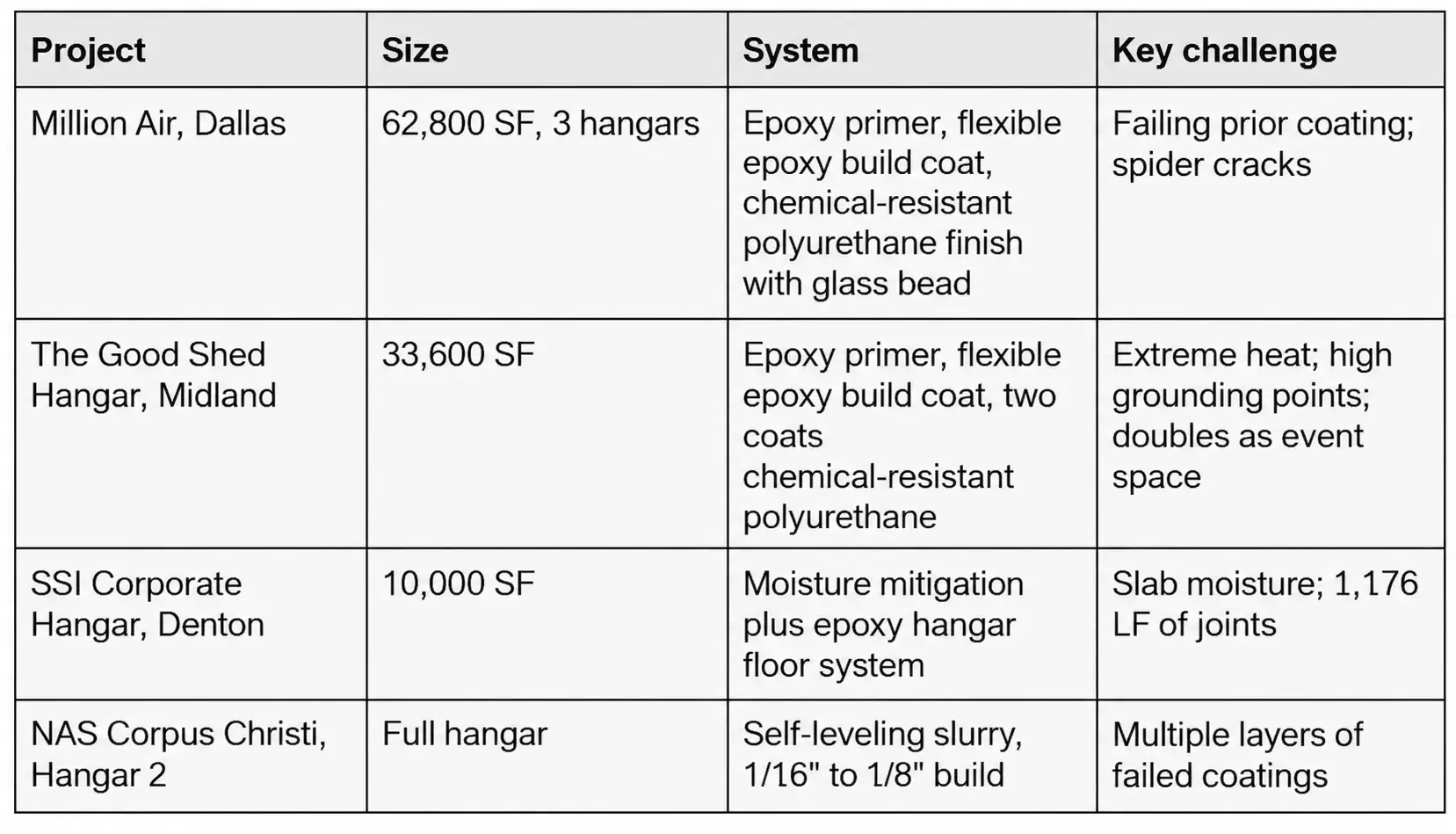
The pattern: a primer for bond, a build coat (often flexible) for crack bridging and body, and a chemical-resistant polyurethane finish for Skydrol, hot tires, and cleanability. Where heavier wear demands it, a self-leveling slurry adds real thickness.
Why most hangar floors fail: prep
Here's an uncomfortable truth.
Two of our four hangar projects started by removing somebody else's failed floor.
At NAS Corpus Christi, Hangar 2 had multiple layers of failed coatings. Years of recoating over problems instead of removing them. We stripped everything back mechanically with concrete scarifiers, diamond grinders, and shot blasting equipment, then prepared the concrete to the manufacturer's written specification.
At Million Air, the existing system was failing from poor craftsmanship. We diamond-ground it off, choosing that method to minimize damage to the concrete underneath.
At SSI Denton, we shot blasted to a CSP-5 profile, diamond-ground the perimeters, and keyed in every doorway and drain edge. The slab also had a moisture problem, so we installed a moisture mitigation system first, a product the manufacturer rates to cut vapor emissions from as high as 25 pounds down to 3 or less per 1,000 square feet per 24 hours.
The coating is the part everyone sees. The surface preparation is the part that decides how long it lasts. (For more on the moisture side, see our guide to moisture testing before you coat.)
The details that bite
Static grounding points. At The Good Shed, the grounding points had been set 3/4" too high in the slab. Left alone, they'd be trip hazards. We tapered the resinous system out around each one to eliminate the risk.
Drainage and fire protection. NFPA 409 governs aircraft hangar construction and fire protection, and many hangars have trench drains designed around fuel spills and suppression discharge. Coordinate coating terminations at those drains with your fire protection design, early.
Heat. Coatings are temperature sensitive, and a Texas summer doesn't care about your schedule. In Midland, we shifted crews to early mornings and late evenings and still delivered 33,600 square feet in 13 days with a six-person crew.
FOD during installation. Working near an active airfield means your crew can't be a source of debris. At Million Air, we policed FOD constantly so no material left our work areas.
Downtime. Hangars can't sit empty for long. We sequenced Million Air one hangar at a time over several weeks, so operations never stopped.
Your hangar floor checklist
Remove failing or unknown coatings completely. Don't recoat over problems.
Test slab moisture, and mitigate if needed
Treat cracks and joints; use a flexible build coat on cracked slabs
Specify a chemical-resistant polyurethane finish rated for Skydrol and Jet-A
Choose light colors and consider glass bead for reflectivity plus grip
Check grounding points and drain details before coating
Coordinate trench drain terminations with fire protection design
Plan phasing so the hangar keeps operating
Frequently asked questions
Can we just polish the hangar slab instead?
In a dry storage hangar with minimal fluids, sometimes. In a maintenance hangar where Skydrol, fuel, and oils hit the floor, a chemical-resistant coating is the safer spec. (See our polished concrete vs. epoxy guide.)
How long does a hangar floor installation take?
It depends on size, prep, and cure schedules. For reference, The Good Shed's 33,600 square feet took 13 days on site.
How long will a hangar floor last?
A well-prepped, properly specified system lasts for years. One of our clients at Signature Flight told us they still see the quality in hangar floors we installed four to five years earlier.
Can a hangar also be an event space?
Yes. The Good Shed doubles as a venue for gatherings, so it needed a floor that was safe, clean, and beautiful, not just durable. The project also won third place in an industry award.
Let's look at your hangar
Tell us what's happening on your floor now: peeling, staining, tire marks, cracking. Tell us what it needs to handle next.
We'll tell you whether it needs a recoat or a full removal, and what system will hold up.
Explore our high-performance coatings, or request a quote.