
Pharmaceutical and Lab Flooring: What cGMP and USP 797 Ask of Your Floor
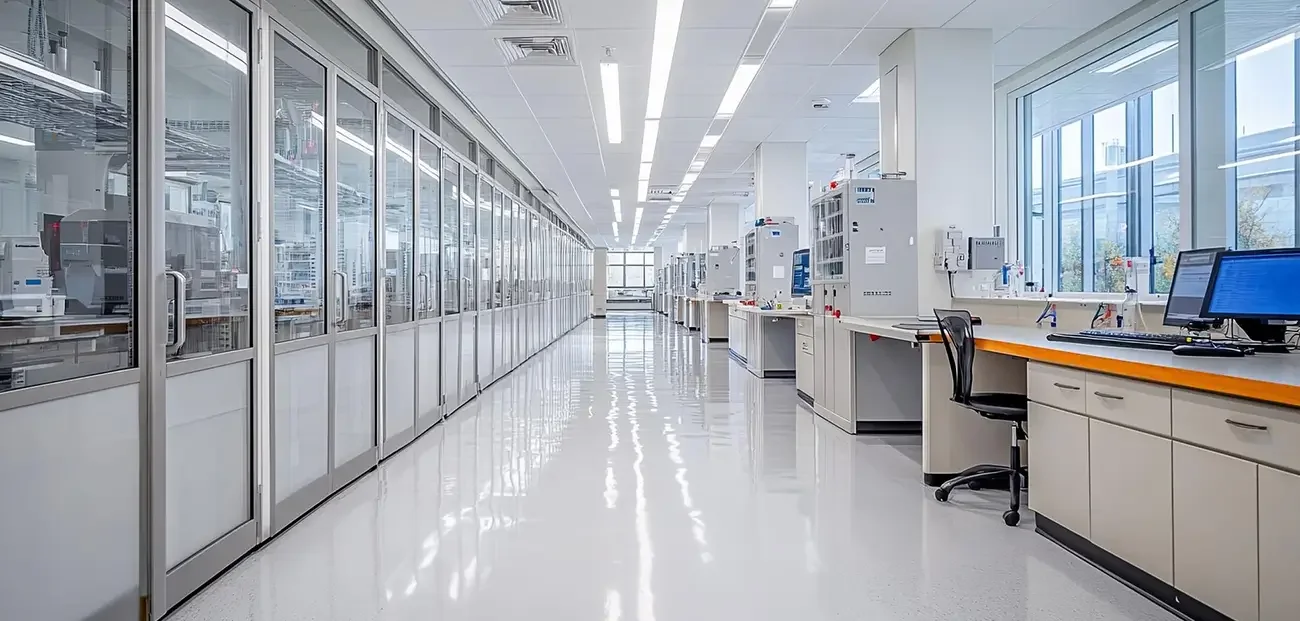
In most buildings, the floor is something you walk on.
In a pharmaceutical facility, the floor is part of your contamination control plan.
Inspectors and auditors know it. That's why they look at the places most people ignore: the seam in the corner, the crack by the door, the spot where the floor meets the wall.
Here's what the standards actually ask of your floor, the five properties that matter, and how to install one inside a facility that can't afford contamination.
What the standards say
FDA cGMP for aseptic processing. Under 21 CFR 211.42, aseptic processing areas need "floors, walls, and ceilings of smooth, hard surfaces that are easily cleanable."
USP <797> for sterile compounding. Cleanroom suite surfaces, floors included, must be smooth, impervious, free from cracks and crevices, and non-shedding, with junctures sealed.
USP <800> for hazardous drugs. Builds on the same idea: surfaces are a containment and contamination control element, and they have to stand up to the cleaning agents used in the room.
Different documents, same message. Your floor needs to be:
Smooth
Impervious
Free of cracks, crevices, and open seams
Non-shedding
Resistant to your cleaning and disinfecting chemicals
Let's take them in the order that trips people up most.
Property 1: No seams, no gaps, no crevices
Every seam is a place contamination can hide.
There are two common ways to handle it:
Sheet vinyl with heat-welded seams. Widely used in cleanrooms, and a legitimate choice. The seams are sealed, but they're still seams, and they have to stay intact.
Seamless resinous flooring. Poured in place as one monolithic surface. No seams to weld, inspect, or fail.
We install resinous systems, so we're not neutral here, and we won't pretend sheet vinyl doesn't work. But for rooms with heavy traffic, rolling carts, and harsh chemical cleaning, a monolithic floor removes a failure point entirely.
Property 2: The floor-to-wall junction
This is where good rooms become great ones.
A 90-degree corner is nearly impossible to clean perfectly. An integral cove curves the floor up the wall in a continuous material, so there's no joint at all.
Now take that idea further.
At UT Health San Antonio, home to South Texas's National Cancer Institute designated cancer center, the research rooms had outdated floors and old glazed brick walls that were hard to clean and could harbor bacteria.
We didn't just replace the floor. We installed a Sikafloor life science floor system and a Sika fiberglass-reinforced wall system, tying floor, walls, and ceiling into a single system and rounding the inside corners.
No junction. No crevice. Nowhere for contamination to hide.
Property 3: Resistance to your disinfectants
Here's the one most specs get wrong.
A floor can be seamless, smooth, and beautiful on day one, then soften, stain, or lose its finish after six months of your cleaning protocol.
Pharmaceutical and lab cleaning is aggressive and relentless. Hydrogen peroxide. Sporicides. Bleach. Quaternary ammonium compounds. Alcohols. Often rotated, often daily.
"Chemical resistant" on a data sheet means nothing until you check it against those specific products, at your concentrations, at your frequency.
Pro tip: send your flooring contractor your cleaning SOP and product list before you pick a system. We'll check each product against the manufacturer's resistance data and flag anything that will cause problems.
Property 4: The right finish in the right room
Smoother is easier to clean. Textured is safer when wet. You usually need both, in different places.
Empower Pharmacy in Houston is a good example. Their 12,616 square foot facility needed flooring built around strict, heavily regulated requirements:
Resistance to chemicals and abrasion, so no outside contaminants reached their products
A glossy finish that staff could easily clean and maintain to FDA expectations
Solvent-free, low-odor materials
A durable, impermeable, seamless surface that prevents dirt and bacteria buildup
Slip resistance where needed, not everywhere
That last point matters. Texture was zoned to the areas that needed it, not applied as a blanket spec.
Property 5: Documentation
In a regulated facility, a floor that performs is only half the job. You need to prove it.
Empower's floor had to be both up to code and well documented to fall within government standards. Plan for product data sheets, installation records, and material information to be part of your closeout, not an afterthought.
Installing inside a live regulated facility
Pharma and lab renovations rarely happen in an empty building. A few things to plan for:
Odor. Adjacent spaces may stay occupied. Low-odor, solvent-free systems keep work from disrupting the rest of the facility.
Dust. Surface prep creates dust. Containment and HEPA-filtered equipment keep it where it belongs.
Moisture. Labs on slab-on-grade need moisture testing before coating. (See our moisture testing guide.)
Return to service. Cure time is only part of it. Build in time for cleaning and any re-certification your QA team requires.
Coordination. Your QA and EHS teams should be in the sequencing conversation from day one.
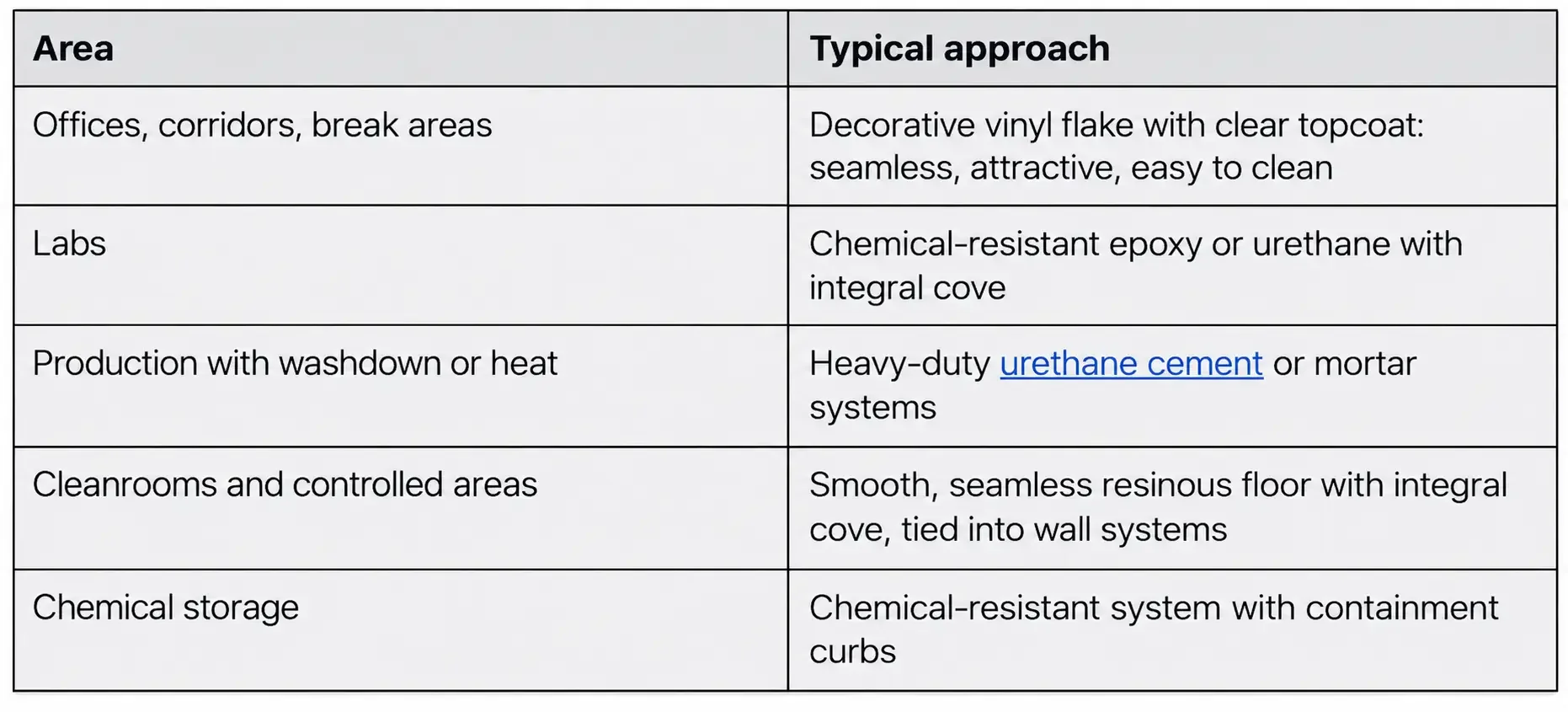
Which system goes where
Your pharmaceutical flooring checklist
Seamless floor, or sealed seams you can maintain
Integral cove at every floor-to-wall junction
Walls and ceilings considered as part of the same surface system
Every disinfectant in your SOP checked against resistance data
Texture zoned by room
Moisture tested before coating
Low-odor materials and dust control for occupied facilities
Documentation built into closeout
Frequently asked questions
Is sheet vinyl or resinous flooring better for a USP <797> cleanroom?
Both are used. Sheet vinyl depends on intact heat-welded seams. Resinous flooring has no seams at all and forms an integral cove. Traffic, carts, chemical cleaning, and repair needs should drive the choice.
Can you install over existing VCT or vinyl?
We remove existing flooring and adhesive down to sound concrete. Coating over old flooring creates exactly the kind of hidden failure point these standards are meant to eliminate.
Can decorative flake work in a pharmaceutical facility?
Yes. Our system uses a clear epoxy binder with vinyl chips, sealed with transparent or UV-stable topcoats, and texture can be adjusted by area. It's well suited to labs, offices, and support spaces.
Can you do the walls too?
Yes. At UT Health San Antonio, we installed floors and fiberglass-reinforced walls as one continuous system.
Let's talk about your facility
Send us your room list, cleaning SOP, and any standards your QA team works to. We'll recommend a system for each space and flag anything that won't hold up to your protocol.
Explore our pharmaceutical flooring systems, or request a quote.