
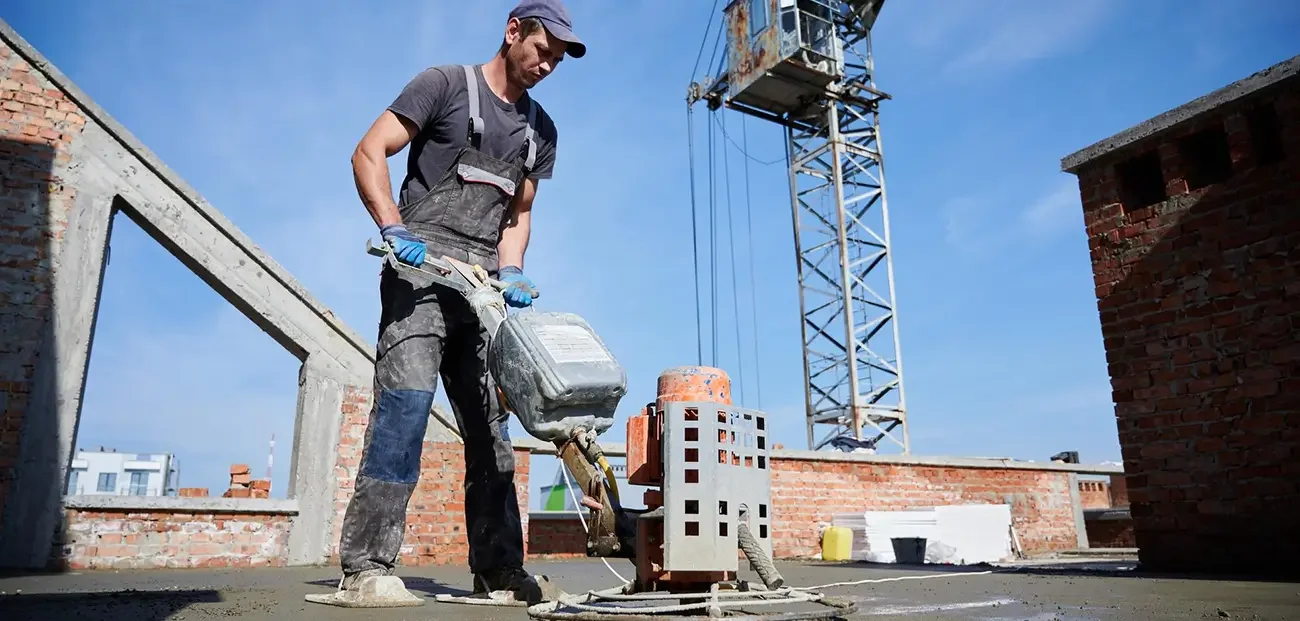
We get a particular phone call a few times a year. It's a facility manager, somewhere between frustrated and furious, describing a floor that went in eight months ago and is now bubbling up like bad wallpaper. Our first question is never about the coating. It's this: do you have the moisture test results? Most of the time, there aren't any.
What's actually happening under a failed floor
Start with a fact that surprises people. Concrete is not dry. Even a slab that's been down for twenty years passes moisture vapor upward all day, every day. It moves by osmosis from the wet side to the dry side, and it carries the slab's natural alkalinity along for the ride. Now put an epoxy coating on top. You've just installed a vapor barrier. The moisture keeps coming. It has nowhere to go. Pressure builds at the bond line. The alkalinity attacks the adhesive bond. Eventually the coating lets go of the concrete. That's the whole failure mechanism. Blisters, then disbondment, then a floor you're paying for twice. It wasn't a bad coating. It wasn't sloppy work. It was a slab nobody tested, coated by someone who assumed it was fine.
The two tests, and what each one really tells you
Two standards matter here. They measure genuinely different things, and specifiers sometimes treat them as interchangeable. They are not.
ASTM F2170: in-situ relative humidity
This is the one we lean on. You drill into the slab, drop a sensor to a specified depth (40% of slab thickness if it dries from one side, 20% if it dries from both), seal the hole, and let it equilibrate. The sensor reads relative humidity inside the concrete. Here's a detail most competitor articles still get wrong. The equilibration requirement used to be 72 hours. ASTM revised it after a precision and bias study showed holes were fully equilibrated at 24. So 24 hours is the current minimum before you can document a reading. Waiting longer hurts nothing, but you're not obligated to. Why RH is the better measure: it reads the slab's condition at depth, not just the skin. It's much harder to fool with surface conditions. And it's what most coating manufacturers now write their warranties against. Probe count matters too. Three for the first 1,000 square feet, then one more per additional 1,000. On a 40,000 square foot warehouse, that's 42 test locations. We've seen "moisture testing" on projects that size amount to two probes near a door. That isn't a test. That's a gesture.
ASTM F1869: calcium chloride (MVER)
The older method. You set a pre-weighed dish of anhydrous calcium chloride under a sealed dome for 60 to 72 hours, then reweigh it. The weight gain gives you a moisture vapor emission rate in pounds per 1,000 square feet per 24 hours. It's still widely specified, and plenty of manufacturers still write limits in MVER. But here's the catch. It only reads the top half-inch or so of slab. Run it on a hot dry day in an unconditioned Texas building and the surface reads beautifully while the slab underneath is soaked. We've watched that exact mismatch play out more than once. Use F1869 when the spec calls for it. Just don't use it alone to make a six-figure decision.
The numbers worth knowing
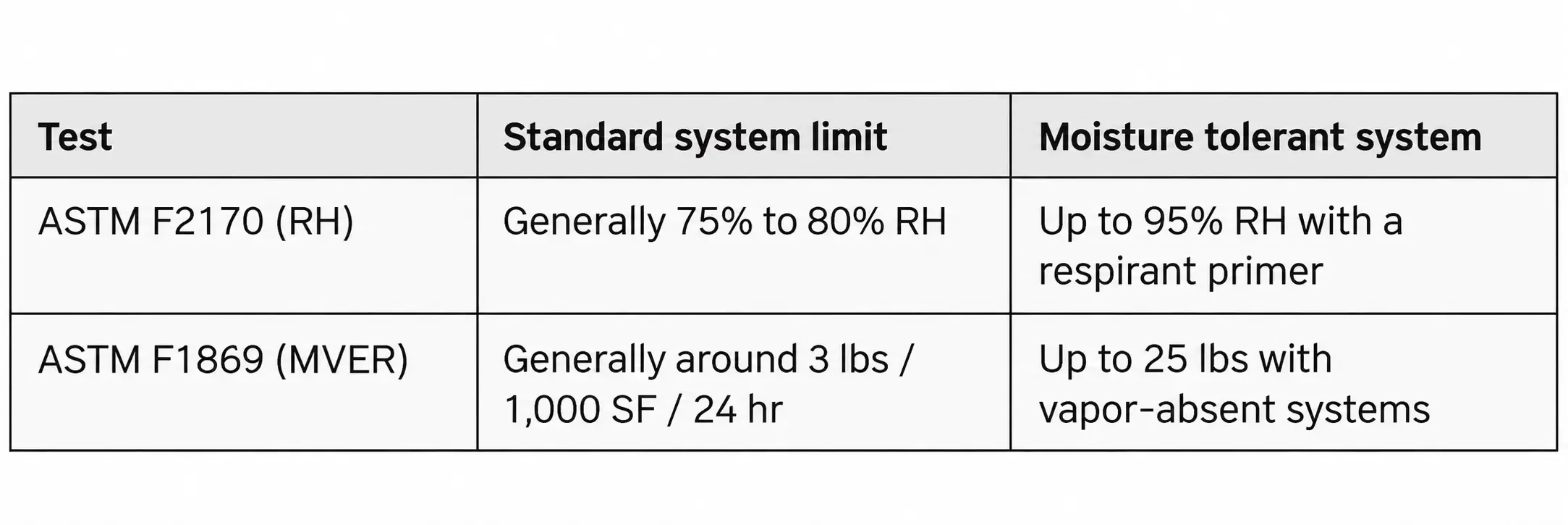
Always work from the actual product data sheet, because every manufacturer sets its own limits. That said, here's the landscape:While you're at it, test slab pH under ASTM F710. High alkalinity degrades adhesive bonds independently of moisture, and it's a cheap test to run alongside.
The requirement everyone ignores
Both standards require the building to sit at service conditions (the temperature and humidity it will actually operate at) for at least 48 hours before testing, and throughout the test. On a live construction site, this is the single most-ignored rule in the whole process. If the HVAC isn't running, you're testing a building that doesn't exist yet. Results from an unconditioned shell in Houston in August tell you very little about that same slab in February with the units online. We've pushed back on schedules over this. It's never a fun conversation. It's a much better conversation than the one about why the floor failed.
Put the 4 days on the schedule
Here's the sequencing problem nobody plans for. RH probes need 24 hours minimum. Calcium chloride needs 60 to 72. Add setup, add the 48-hour conditioning window ahead of all of it, and moisture testing is realistically a four to five day item. And it has to finish before coating starts. Not concurrent with it. New slabs add a wrinkle. Traditional guidance says roughly 28 days of cure before testing, and even then a slab can easily come back too wet. We've tested 45-day-old slabs in enclosed buildings reading well above 90% RH. Concrete dries slower than anyone's schedule wants it to. That's not an argument for skipping the test. It's an argument for putting it on the schedule in preconstruction, where it costs you nothing but a calendar entry.
Your slab failed the test. Now what?
Good news first: a failed moisture test is not a dead project. It's a scope change. You have three routes.
Route 1: Let it dry. Free, but slow. On most commercial schedules, slow isn't available.
Route 2: Install a moisture mitigation system. A 100%-solids epoxy vapor-reduction primer over a properly profiled slab, rated to hold back high RH. It adds real cost per square foot. It also costs a fraction of a failed floor, and it protects both your schedule and your finish selection.
Route 3: Change systems. Urethane cement is vapor-permeable and tolerates slab moisture that would kill epoxy. If the room suits it (wet process, washdown, food, thermal cycling), this might be the right answer anyway. We wrote a full comparison of epoxy and urethane cement if you're weighing it.
Which route wins depends on your schedule, your budget, and what the room has to do. Anyone who hands you a universal answer without seeing the numbers is guessing.
Prep is the other half of this
Moisture testing tells you whether the slab is ready chemically. Surface preparation tells you whether it's ready mechanically. That means shot blasting or diamond grinding to the concrete surface profile the manufacturer specifies (typically CSP 3 to 5, depending on system thickness). Crack and joint treatment. Stripping curing compounds, sealers, and old coatings. Clean termination details at drains, doors, and trench edges. We run both as one process, because they answer two halves of the same question: is this substrate ready to hold a coating for the next twenty years? On the 1.5 million square foot semiconductor fab we completed in Sherman, our scope covered floors, curbs, trenches, sumps, pits, and electrical lids. Every one had its own substrate condition and its own prep requirement. You don't get through 543 days of that on assumptions.
Frequently asked questions
Who pays for moisture testing?
It varies by contract. Settle it in preconstruction, before somebody's already drilled a hole. We'd much rather have that conversation early than watch testing get quietly dropped because nobody owned it.
Can you test through an existing coating?
No. The coating comes off at each test location, because you're measuring the slab, not the film on top of it.
Our slab is 15 years old. Do we still need to test?
Yes. Age is not dryness. A slab with no vapor retarder under it, or one sitting over a high water table, or one that took a plumbing leak, will pass moisture indefinitely. Some of the wettest slabs we've ever tested were decades old.
What if the results come back borderline?
Treat borderline as failing. Manufacturer limits are limits, not targets, and site conditions move. A slab reading 84% against an 85% limit in an unconditioned building in April is not a slab we'd coat without mitigation.
We have a vapor retarder under the slab. Can we skip testing?
No. It helps a lot, but retarders get punctured during construction, and a retarder does nothing about water that entered the slab from above during the build. Test anyway.
Before you coat, test
We've installed more than 500 million square feet across Texas, Oklahoma, and Louisiana. We have never once regretted spending the four days. Got a project coming up? Talk to us during preconstruction, not after the slab is poured and the schedule is locked. That's when this is cheap to get right. Contact T.W. Hicks or request a quote, and we'll walk your project through what testing it needs and where it belongs on the schedule.