
Recoat or Remove? How to Handle a Failing Industrial Floor Coating

Every failing floor triggers the same first instinct.
"Can we just put another coat on it?"
Sometimes, yes. Recoating a sound floor before it wears through is one of the smartest maintenance moves you can make. But coating over a failure doesn't fix it. It buries it. And the bill comes later, bigger.
We saw exactly that at Hangar 2 at Naval Air Station Corpus Christi. The floor had multiple layers of failed coatings, the result of years of recoating instead of removing it back to bare concrete. Every layer made the next failure harder and more expensive to fix. (Running a hangar? Our hangar floor guide covers the Skydrol and hot tire problems behind many hangar failures.)
So let's make the call correctly. Here's how to diagnose what's happening, the test that settles it, and what to do next.
Step 1: Read the symptoms
Different failures leave different fingerprints. Start here.
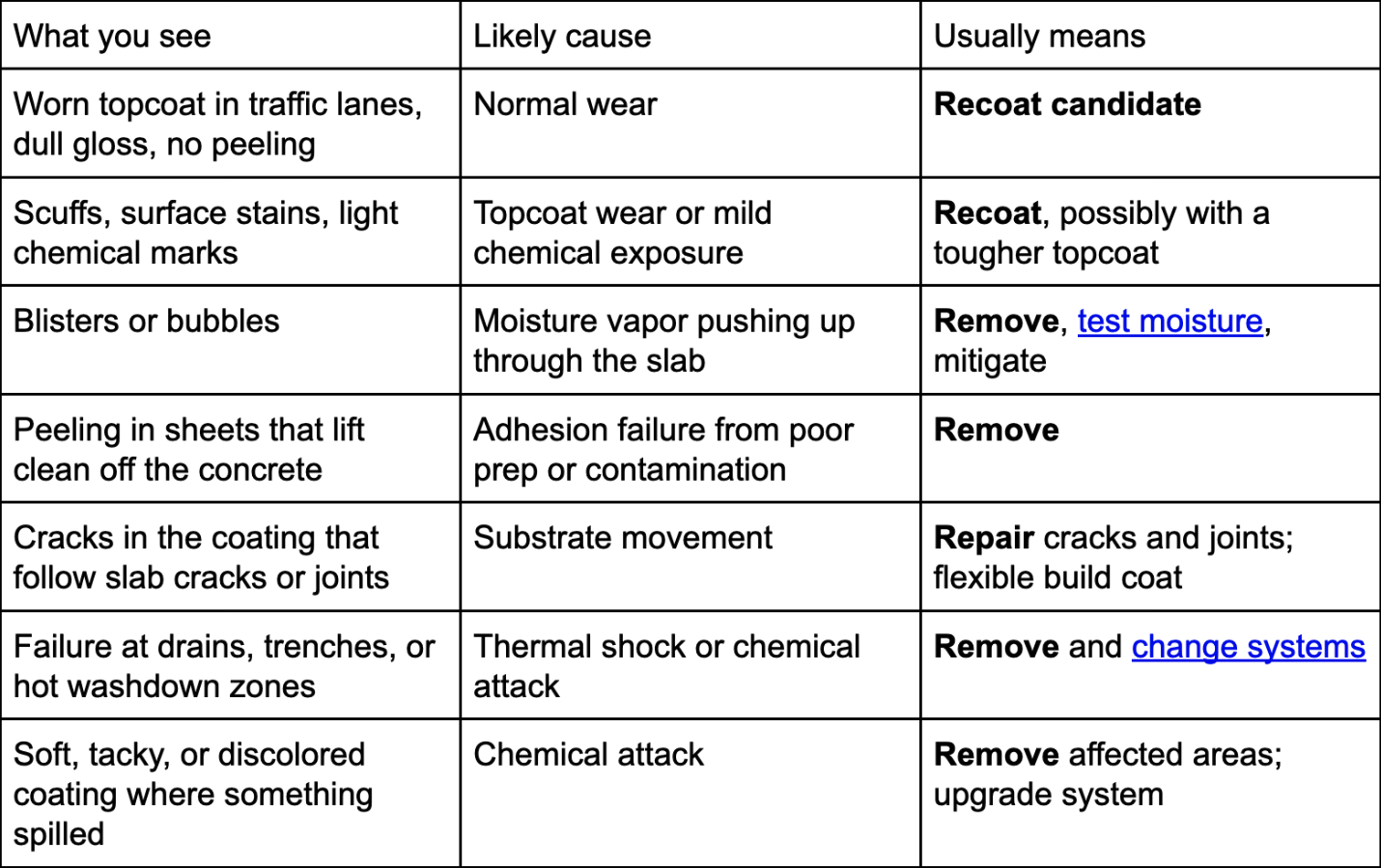
Pro tip: pick up a loose piece of failed coating and flip it over.
Concrete stuck to the underside? The coating bonded well. The concrete surface itself was weak.
Clean underside? The bond failed. That points to prep, contamination, or moisture.
Step 2: The test that settles it
Eyes get you close. Testing gets you certain.
ASTM D7234 is the standard test for pull-off adhesion of coatings on concrete. Here's how it works:
A metal test dolly is glued to the coating surface.
A portable tester pulls the dolly straight up at a controlled rate.
The tester records the force when it lets go.
You inspect where it broke.
That last step matters as much as the number.
If the break happens in the concrete, the coating is holding on better than the concrete can. That's a sound bond, and a floor you can build on.
If the break happens at the bond line, the coating isn't really attached. Recoating adds weight to something that's already letting go.
Test in several places, including the worst-looking areas. A floor can be sound in the office corridor and failing at the loading dock.
When recoating is the right call
Recoat when:
The existing system is well bonded
The damage is wear, not failure
The new topcoat is compatible with what's already down
The room's conditions haven't changed
A proper recoat still takes real prep: deep cleaning, degreasing, and mechanically abrading the surface so the new coat can grip. Skip that and you've just bought a peeling topcoat.
The best time to recoat is before you have to. Refreshing a worn topcoat protects the build coat underneath, which is far cheaper than replacing the whole system. That's the logic behind our floor maintenance program. Good daily floor care stretches that window even further.
When removal is the only real option
Remove when:
Adhesion testing fails at the bond line
You see blistering from moisture
There are multiple layers of old coatings, or nobody knows what's down there
The system was wrong for the room from the start
Removal is done mechanically. Depending on the coating and thickness, that means diamond grinders, scarifiers, and shot blasting. At NAS Corpus Christi, the layered failures required all three.
Tool choice matters. At Million Air Dallas, we used diamond grinders specifically to minimize damage to the concrete under the failing coating.
Then the slab gets profiled to the concrete surface profile (CSP) the new system's manufacturer calls for. At the SSI hangar in Denton, that meant shot blasting to CSP-5.
Step 3: Fix the cause, or it fails again
Here's the most important lesson in this article.
The coating is rarely the root problem.
Replace a failed floor without fixing what caused the failure, and you're scheduling the next one. Three real examples:
Cracks at Million Air. The three hangars (62,800 square feet) had spider cracking under a coating that was failing from poor workmanship. After removal, we specified a flexible epoxy build coat to keep those cracks from transferring into the new system.
Cold joints at American Licorice. Our division manager saw that hairline cracks at cold joints could come back through a new floor. So before installing 43,868 square feet of 3/8" urethane cement, we bridged every cold joint with flexible epoxy underlayment and fiberglass mesh.
Moisture and joints at SSI Denton. The slab needed moisture mitigation first, so we installed a system the manufacturer rates to reduce vapor emissions from as high as 25 pounds to 3 or less per 1,000 square feet per 24 hours. We also routed out 1,176 linear feet of control joints, installed backer rod, and filled them before coating.
Different floors. Same principle. Find the cause, fix the cause, then coat.
Planning around downtime
Recoats are relatively fast and can often fit into a weekend or a short shutdown.
Removal means more dust, noise, and days. Plan for containment, phasing, and cure time.
If you can only shut down one area at a time, say so up front. We sequenced Million Air one hangar at a time over several weeks so operations kept running.
Before you call anyone, gather this
Photos of the worst areas, plus a wide shot for context
When the problems started, and whether they're spreading
What gets spilled on the floor, and how it's cleaned
Any original product data sheets or installation records
How long you can take each area out of service
With that, a good contractor can tell you a lot before they ever set foot on site.
Frequently asked questions
Can you coat over a floor that has old adhesive or mastic on it?
No. Adhesive and mastic residue break the bond and can bleed through. It comes off mechanically first.
Will removal damage our concrete?
Proper prep deliberately roughens the surface so the new system can bond. The right tooling minimizes unnecessary damage, and any existing damage it uncovers gets repaired before coating.
How long does removal take?
It depends on the coating type, thickness, number of layers, and square footage. Multiple old layers take longest.
Will a manufacturer warranty a recoat over another contractor's floor?
Often not, because they can't verify what's underneath. If a system warranty matters to you, full removal is frequently the path to getting one.
Let's find out what's really happening
Send us photos and a short description of what you're seeing. We'll tell you whether it looks like a recoat, a removal, or something that needs testing first.
Learn more about our concrete preparation and high-performance coatings, or request a quote.