
Surface Preparation: Grinding
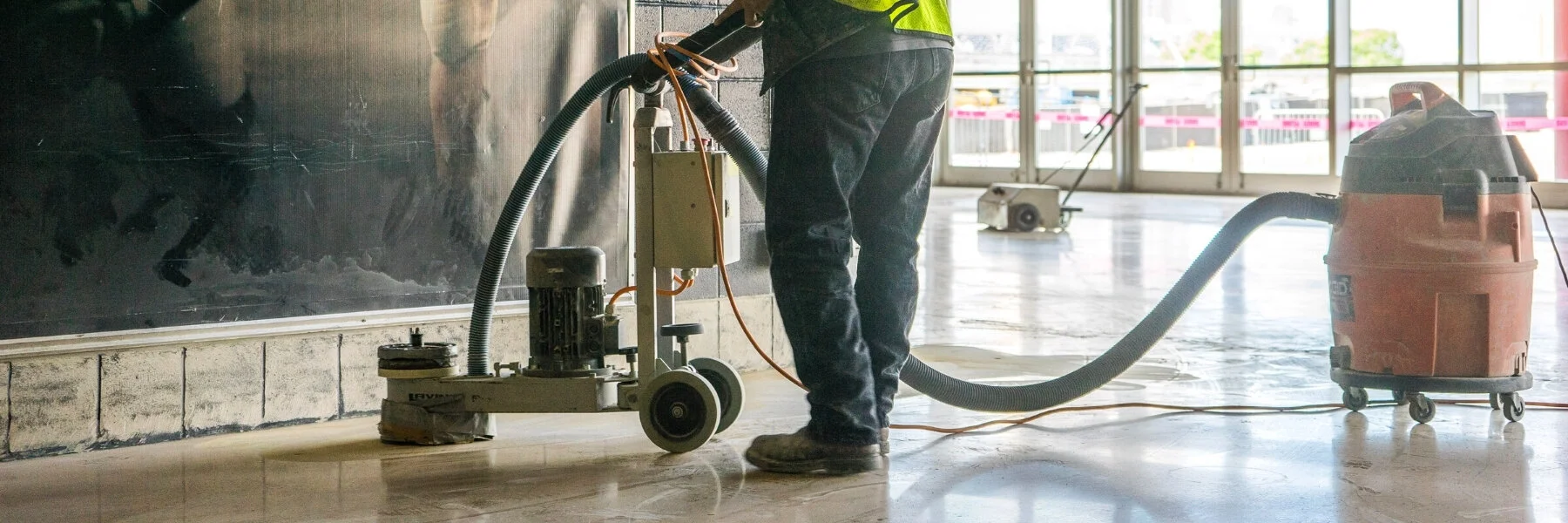
Grinding has become a very popular concrete preparation method since the concrete polishing movement. Diamond grinders used in the polishing process have made a huge impact on how we use grinders as a mechanical preparation tool. Advancements in diamonds that are used make grinding a great way to achieve a CSP 1-3 profile for thinner resinous flooring systems without getting blast lines in the concrete substrate that can telegraph through on thinner resinous flooring systems. Grinding is also a great way to remove failing thin film resinous coating systems, mastics under tile, and thin set grout without damaging the concrete substrate below the coating. Grinding can also be used to profile existing resinous floor systems for recoats. The vacuum systems used on grinding equipment allows us to be able to control the dust and debris, unlike traditional orbital sanders loaded with sanding screens when doing a sand and recoat.
AN INSIDER’S VIEW
Not many things have changed in our industry since I have been involved in industrial flooring except the price of products and diamond grinders! I have not really thought too much about it until I was asked to write about all of the different preparation methods we use every day on our job sites. Now as I sit here and start thinking back about the changes in diamond grinding equipment there is no question it has been the biggest change in our industry.
Thanks to polished concrete, diamond grinders have become the hottest piece of equipment in the marketplace. This has helped those of us that are required to prepare concrete substrates to provide a certain profile for adhesion. The diamond grinders we use today come in all different sizes, head configurations and power sources. They utilize rotating disks to level, smooth, clean and profile concrete substrates. Depending on the head configuration used on the diamond grinder, it can be used to provide a light profile for a thin film coating system or to remove glues, coatings or overlayments. Diamond grinders can also be loaded with many different types of cutters and slicers to quickly cut through heavy built up systems as well as elastomeric coatings and overlayment systems.
DIAMOND GRINDING AND CONCRETE SURFACE PROFILES
When we are using diamond grinders to profile the concrete surface for adhesion it is important to know and understand the concrete surface profile (CSP). Product manufacturers will recommend a CSP profile for the system they are specifying and it is up to the installer to make sure this profile is met. We typically utilize our diamond grinders when we are asked to provide a CSP 2-3-4 profile. These profiles are easily achieved with the diamond grinders as long as the proper diamonds are utilized on the heads.
Check out this website for more details on CSP profiles and diamond segment selections https://www.werkmaster.com/concrete-profiling/
Production rates will vary based on the type of concrete substrate, size of machine being used, type of diamonds the machine is loaded with and configuration of the space you are trying to prepare. Sizes vary from 12” wide up to 31” wide.
Check out this link to see all of the different options https://www.blastrac.com/grinding-polishing/
The video below shows how the diamond grinder works